Me and You How to Play
Rule blocks, pushes, win conditions, and Baba-like logic explained for two players.
The big idea
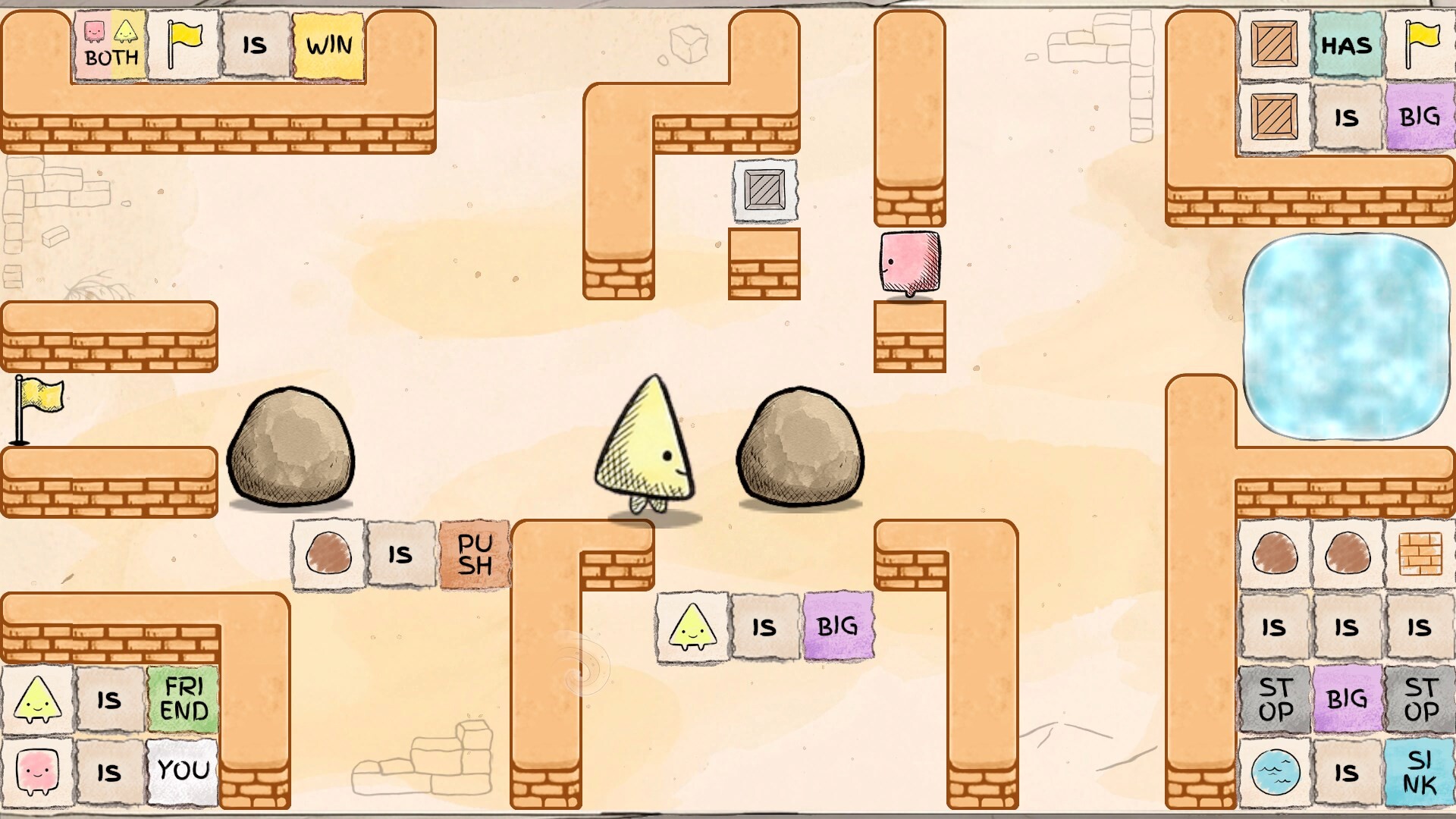
Me and You asks you and a partner to rewrite each level’s rules by pushing word blocks around the grid. Paper scraps, rocks, walls, and other pieces are not only scenery—they can be the nouns and verbs of living sentences. When a valid sentence lines up, the world obeys it immediately: someone becomes controllable, a wall stops being solid, a flag becomes the goal, or your partner turns into a door you both need.
The game is openly inspired by Baba Is You, but every puzzle is tuned for two bodies in one rule space. If you only memorize single-player Baba habits, you will miss solutions that require one player to hold position while the other edits text.
New to the franchise feeling? Install the demo, then return here with the board in front of you.
Anatomy of a rule
Most readable rules follow a simple pattern:
NOUN + IS + PROPERTY (or another noun)
Examples of the kind of sentences you will manipulate (demo-inspired patterns, not an official exhaustive dictionary):
- Something IS YOU — that object becomes player-controlled.
- Something IS WIN — touching it while you are YOU clears the level.
- Something IS STOP — it blocks movement like a solid wall.
- Something IS PUSH — you can shove it like a crate.
Word tiles are typically pushable themselves. Separating a sentence disables the rule; completing a new sentence enables a new truth. For a longer word list with caveats, open the rule glossary.
What you actually do each turn
- Survey — Count active sentences. Say them aloud to your partner.
- Assign roles — Who escorts a critical noun? Who fetches WIN? Who stands on a pressure-like spot if the level needs a body in place?
- Push — Move word blocks and objects. Avoid trapping text in corners unless that is intentional.
- Observe — The moment a rule completes, sprites and collisions can change. Pause and re-read.
- Win check — A controllable YOU must interact with a valid WIN condition (or an equivalent win rule the level allows).
- Undo / restart — Experiment freely; softlocks are normal in rule games.
Co-op-specific mechanics mindset
Because both players act, Me and You leans on ideas such as:
- Split agency — Each of you may control different objects if multiple YOU rules exist, or you may share complementary jobs even under one control scheme depending on level design.
- Body as tool — Standing still is a mechanic. Blocking a path, holding a pushed chain, or becoming the object the rule names can be the intended trick.
- Unexpected identities — Trailer and store copy highlight turning a friend into a door, rock, or wall. Mentally allow “my partner is the keyhole”as a valid plan.
- Shared win — Progress is party-wide; there is no race to steal the flag alone if the level still needs both of you conceptually present in the solution.
Watch the embedded co-op gameplay clip mid-article to see rule edits happen at conversational speed, then try the same narration style in your session.
Win conditions without spoilers
Winning usually means a YOU-controlled entity coincides with something that IS WIN, or a rule makes the controllable object itself win. Losing all control (no effective YOU) often means you must undo. Destructive properties—if present in a level—can erase your win path if you rush.
Teach yourselves this mantra: Never celebrate a WIN rule until you still have a YOU.
Reading the board like a team
Try this script on every new screen:
- “What is currently YOU?”
- “What is currently WIN?”
- “What is STOP or PUSH that we care about?”
- “Which words are free versus trapped?”
- “What hilarious illegal-sounding sentence might be legal here?”
If answers disagree, stop pushing until you agree. Most “bugs”in rule puzzles are misread sentences.
Practice plan
- Clear early Chapter 1 rooms in the demo while narrating rules.
- On purpose, break a working rule and rebuild it so your hands learn the grammar.
- When stuck for ten minutes, skim co-op tips or the gentle demo walkthrough rather than rage-resetting silently.
- Keep controls open if one of you swaps to gamepad mid-session.
How this differs from “just Baba”
Solo Baba teaches you to be a careful editor. Me and You teaches you to be a careful editor and a teammate who might become the edit. Expect puzzles that waste your time if you ignore the second avatar. That is the point—and the joke.
Master the push grammar, talk constantly, and treat every noun as a costume your partner might wear. Then move on to harder Chapter 1 challenges with confidence.
Frequently Asked Questions
Quick answers to the most common questions.
What does IS YOU mean?
Objects tied to a YOU rule are what you control. Without an effective YOU, you usually cannot progress—undo and rebuild. More terms sit in the rule glossary.
How do we win a level?
Typically a YOU-controlled object must touch or become a WIN condition. Details and edge cases are discussed above and practiced in the demo walkthrough.
Are all Baba Is You words in Me and You?
Not necessarily. Treat glossary entries as Baba-inspired patterns seen in demo coverage, not an official complete list.
Where should we go next?
Practice with co-op tips, then tackle Chapter 1 via the demo walkthrough.